By Senior Chief Mass Communication Specialist John Osborne, Navy Office of Community Outreach
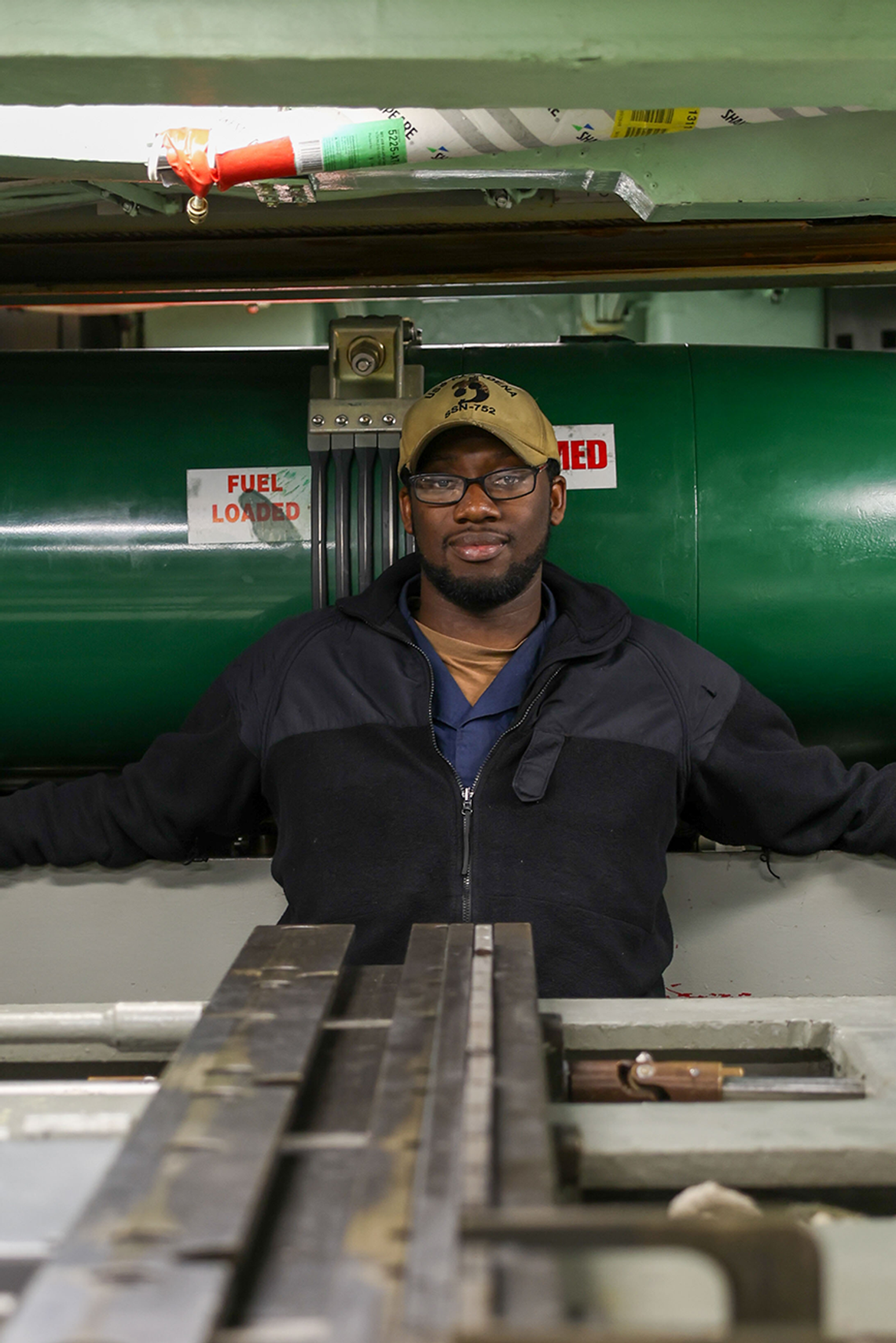
Seaman Julian Pringle, a native of Sanford, Florida, is one of the sailors serving aboard USS Pasadena, continuing the U.S. Navy’s 124-year tradition of service under the sea.
Pringle graduated from Lake Mary High School in 2020. |
The skills and values needed to succeed in the Navy are similar to those found in Sanford. |
“I learned early on to treat everybody with respect,” Pringle said. "You never know when you meet someone what they are going through, so it's best to always give out positive energy because someone may really need it." |
Pringle joined the Navy one year ago. Today, Pringle serves as a torpedoman's mate. |
“I had always promised myself that if I wasn't going anywhere by 2021, I would join the Navy,” Pringle said. "I'm happy I joined and that I chose submarines. The camaraderie on a submarine is so great. My only regret is that I am not in Japan." |
Known as America’s “Apex Predators!,” the Navy’s submarine force operates a large fleet of technically-advanced vessels. These submarines are capable of conducting rapid defensive and offensive operations around the world, in furtherance of U.S. national security. |
There are three basic types of submarines: fast-attack submarines (SSN), ballistic-missile submarines (SSBN) and guided-missile submarines (SSGN). |
Fast-attack submarines are designed to hunt down and destroy enemy submarines and surface ships; strike targets ashore with cruise missiles; carry and deliver Navy SEALs; conduct intelligence, surveillance, and reconnaissance missions; and engage in mine warfare. The Virginia-class SSN is the most advanced submarine in the world today. It combines stealth and payload capability to meet Combatant Commanders’ demands in this era of strategic competition. |
The Navy's ballistic-missile submarines, often referred to as "boomers," serve as a strategic deterrent by providing an undetectable platform for submarine-launched ballistic missiles. SSBNs are designed specifically for stealth, extended patrols and the precise delivery of missiles. The Columbia-class SSBN will be the largest, most capable and most advanced submarine produced by the U.S. - replacing the current Ohio-class ballistic-missile submarines to ensure continuous sea-based strategic deterrence into the 2080s. |
Guided-missile submarines provide the Navy with unprecedented strike and special operation mission capabilities from a stealthy, clandestine platform. Each SSGN is capable of carrying 154 Tomahawk cruise missiles, plus a complement of heavyweight torpedoes to be fired through four torpedo tubes. |
Strategic deterrence is the nation’s ultimate insurance program, according to Navy officials. As a member of the submarine force, Pringle is part of a rich history of the U.S. Navy’s most versatile weapons platform, capable of taking the fight to the enemy in the defense of America and its allies. |
The U.S. Navy is celebrating its 250th birthday this year. |
According to Navy officials, “America is a maritime nation and for 250 years, America’s Warfighting Navy has sailed the globe in defense of freedom.” |
With 90% of global commerce traveling by sea and access to the internet relying on the security of undersea fiber optic cables, Navy officials continue to emphasize that the prosperity of the United States is directly linked to recruiting and retaining talented people from across the rich fabric of America. |
Pringle has many opportunities to achieve accomplishments during military service. |
“My proudest accomplishment so far is that I made it through 'A' School and that I have survived my first year on the submarine,” Pringle said. "I owe all of that to the great people I serve with on the boat." |
Pringle has many goals for their Navy career. |
“My goal is to continue to show the boat that I am reliable,” Pringle said. "I am one week away from testing for my dolphins qualification, which will make me a true submariner. Ultimately, I want to earn a commission as an officer.” |
Pringle serves a Navy that operates far forward, around the world and around the clock, promoting the nation's prosperity and security. |
“Serving in the Navy means I have accepted that I am going in a different but positive direction in life,” Pringle said. "It also means I have accepted that I'm willing to learn and try to be better each day." |
Pringle is grateful to others for helping make a Navy career possible. |
“I want to thank my chief, who has kept me from losing it a couple of times,” Pringle added. "I also want to thank my recruiter and my 'A' School instructors for shooting me straight and always keeping things real. Most of all, I want to thank my sister and my dad who have supported me and encouraged me throughout my life and career." |