By Fabio Braggion
Herald Intern
The Planning and Zoning Commission, on a 4-3 vote, recently approved the plans submitted by 1000 East First Estates LLC, partnering with the New York-based evangelical missionary group World Olivet Assembly, to renovate the old Mayfair Hotel.
“To be clear, this project will neither operate as a church nor as a school,” said Alma Osario, the director of the Mayfair Planned Development Project at World Olivet Assembly during an email interview.
1000 East First Estates LLC is a Florida Limited Liability Company based out of 61 Broadway 2809 in New York, New York. It was registered in September 2021, almost a year before World Olivet Assembly announced ownership of the building on their website for their Olivet News in June 2022. The name of the LLC is similar to the address of the Mayfair Hotel, located at 1000 East First Street.
The applicants described their plans for the building as an “apartment-office building”, covering two out of the three uses the building is currently planned for. The third was an additional use added a month before the Oct. 2 Planning and Zoning Commission meeting, a museum.
This is the third time the applicants have met with the Planning and Zoning Commission to renovate the building. A year after they bought the building in 2022, they submitted the first draft of their renovation project to the Planning and Zoning Commission, where they were denied. The plan called for a place for worship, vocational school and 161 dormitory rooms.
“We recognized that aspects of that concept were not the best fit for the zoning framework or our long-term plans,” said Osario.
The second time they met with the Planning and Zoning Commission was this year, on Sept. 4, where their lengthy presentation caused the meeting to go into overtime and they were asked to continue in the Oct. 2 meeting. At this point, their renovation plan had significantly changed. They had gotten rid of the vocational school and a place for worship, for 28,000 square feet of professional office space. They also replaced the 161 dormitory rooms with 46 multi-family residential units, 36 on the upper floors of the hotel and 10 in the annex building adjacent to the property, according to Osario.
These multi-family rooms will be used to house “trainees”, workers for the World Olivet Assembly being paid $26,000 to $36,400 a year learning “administration, finance, ministry-related work, public relations, leadership, and other disciplines,” said Osario.
During this Sept. 4 meeting, city staff neither recommended to deny nor approve the renovation project, but did request the applicant to reduce the number of parking spaces in order to “preserve the historical character of the building.” City staff were also concerned about the lack of public connectivity to the hotel.
“As a religious organization, the function and operation of World Olivet Assembly administrative offices is designed to be a private space that neither encourages pedestrian activity nor will it attract potential users to the downtown area,” reads the city staff’s report.
The applicants continued their presentation in the Oct. 2 meeting with a couple of changes to the renovation plan. After meeting with city staff, they reduced the number of parking spaces from 204 to 130, only five fewer than the 135 allowed by code. The parking also shifted from the front of the building to the side surrounding the less historically important annex building. They also added three new additions that would address the issue of public connectivity.
The first is a “plaque of acknowledgement” thanking the current board members, the mayor, and the city for allowing them to renovate the building. Second is a reduction in office space from 28,000 square feet to 27,450 square feet, designating 550 square feet for the “Mayfair Store” and the “Exhibition Room”, a gift shop and museum run by World Olivet Assembly detailing the history of the hotel and their missionary work. This comes with their third change, a condition added by the committee during the final moments of their presentation, a public lobby, allowing visitors to walk from East Seminole Boulevard through the building to East First Street.
“World Olivet Assembly viewed this as an opportunity that would allow us to continue our mission and, at the same time, to restore one of Sanford’s most historic buildings and ensure a sustainable long-term use,” said Osario, expressing a sentiment that many held during the Planning and Zoning Commission meeting, the fear that without renovations the building may be torn down.
“I would much rather it be saved and used, even if it’s not used for the purpose I would like it used for,” said Art Woodruff, Mayor of Sanford.
Woodruff read the city staff report and agreed that public connectivity of the building would be an issue. Like some on the Planning and Zoning Commission, Woodruff would like the building to be renovated and used as a preferable outcome to seeing it deteriorate and eventually be torn down.
The history of the Mayfair Hotel begins even before Sanford was called Sanford. In 1837, when Sanford was known as Mellonville, the property was the site of a battle during the Second Seminole War between U.S. troops and Seminole Indians adjacent to Camp Monroe, later titled Fort Mellon, according to a board member of the Seminole County Historical Society, Daniel N. Ruoss.
“There was an old county historian named Annie Whitner, she arrived in Mellonville after the war, recalled in 1914, ‘the cemetery sat near the shore of the lake where Captain Mellon fell,’” said Ruoss.
Her testimony and the location of the property have led Ruoss to the conclusion that there might be a U.S. soldier burial ground on the site of the Mayfair Hotel. One that may be disturbed by the new renovations.
“Obviously, if they’re going to be putting in all that new paving for the parking, that’s what we think could be disturbed, that it would be on the grounds, on the green space. That’s our best theory,” said Ruoss.
If human remains are found, they must be treated in accordance with Florida law. If an entire cemetery is found, it could put a stop to any renovations outside of the building. Then the dimensions of the cemetery would be marked out and made off-limits.
“We wanted to raise the concern just so that it’d be known that’s something to look for,” said Ruoss.
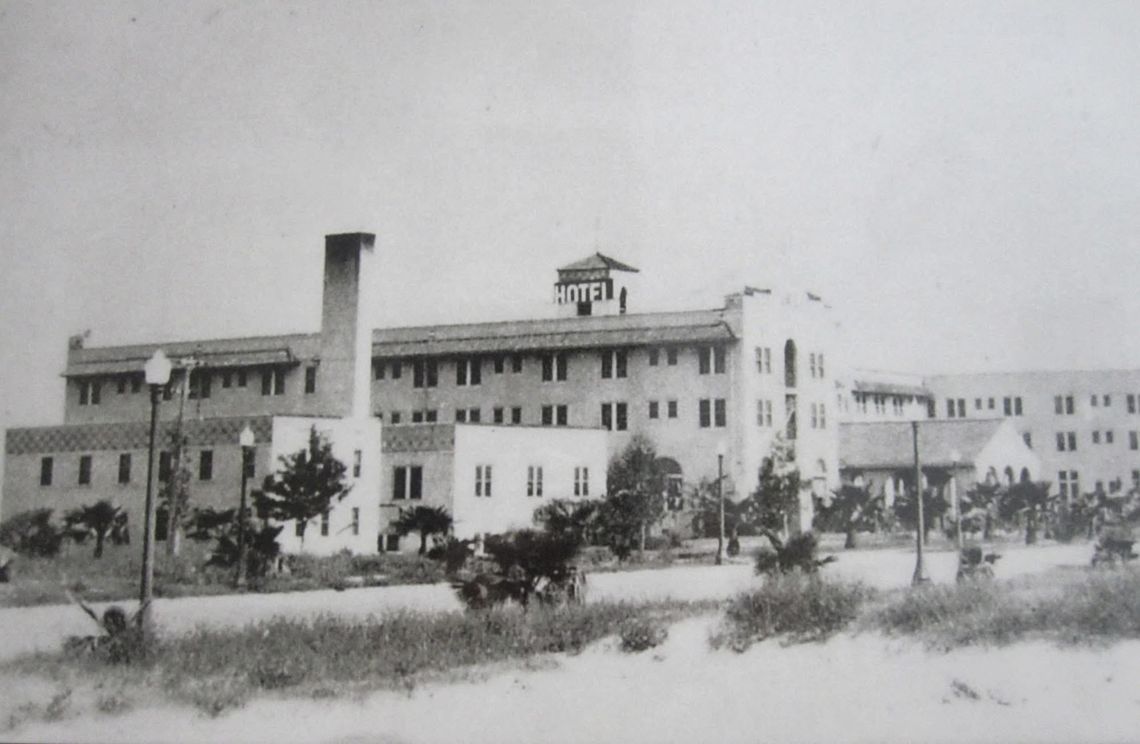
The building we know as the Mayfair Hotel was first constructed in 1925 by local architect, Elton J. Moughton in a Mediterranean Revival style, according to Brigitte Stephenson, a curator for the Sanford Museum. At the time, it was called the Forrest Lake Hotel, named after the then-mayor of Sanford, Forrest Lake.
“It was supposed to be the great new hotel that replaced the old Sanford House Hotel, built by Henry Shelton Sanford, that was torn down to make way for the construction boom of the 1920’s,” said Stephenson.
Its initial luster faded quickly after Mayor Lake was caught embezzling one million dollars in 1928 and was sent to jail. In 1930, the city bought the hotel and watched as it exchanged hands several times with no one to run it.
“The city, in 1934, made a deal with W.E. Kirchhoff, Jr., in December of 1934, that by February 15 in 1935, he had to have the place open, he had to have 30 rooms ready to rent, to be furnished and everything,” said William (Bill) Kirchhoff, the son of W. E. Kirchhoff Jr., the owner of the hotel from 1934 to 1948.
According to Bill Kirchhoff, the city released the hotel to his dad, W.E. Kirchhoff Jr. in phases every year. For the first year, they gave him thirty rooms and rented out the hotel for $750; adjusted for inflation today, that’s $17,000. The next year, they gave him another thirty rooms and increased the rent to $1,500, which is $35,000 today. To furnish these rooms in such a short amount of time, he took advantage of his previous business.
“He shipped flowers (gladiolas) up to New York City, and so when the truck would come back, they stopped at Atlantic City, where they were auctioning off all the bankrupt hotels' stuff in Atlantic City. And so he bought the stuff he needed there and brought it back and built it up,” said Bill Kirchhoff.
By 1937, W.E. Kirchhoff Jr. bought the hotel for about $15,000 ($224,000 today). By that point, he had moved his family into the hotel, including a young Bill Kirchhoff.
“From Dec. 20 of 1934, to Feb. 15 of 1935, they didn't think he could do that,” said Bill Kirchhoff.
During Kirchhoff’s residency, World War II broke out, leading the Navy to take over the hotel and Kirchhoff to relocate to Bradenton. By the end of the war, the hotel ran for a couple more years until a hurricane hit Sanford, causing the roof to leak.
“To put a new roof on it costs you $10,000, and so he said, ‘Well, I paid $15,000 for it, and it cost $10,000 to put on a roof, I think I might better get rid of it.’ He was being facetious,” said Bill Kirchhoff.
W. E. Kirchhoff Jr. sold the hotel to Horace Stoneham, owner of the New York Giants, who used the hotel for spring training, changing the name to Mayfair Inn. He undertook his own renovation project, bringing the building up to the current code, installing a new kitchen, and constructing the annex building.
It was at this time that Jackie Robinson played in Sanford for only three innings until he was forced to stop, according to Bill Kirchhoff. The Giants owned the hotel from 1948 to 1963 when they moved from New York to San Francisco.
Stoneham sold the hotel to the Bernarr Macfadden Foundation in 1963, which was a foundation started by the “Father of Physical Culture,” Bernarr Macfadden. According to the foundation's website, he ran a health magazine titled Physical Culture beginning in 1899. By the time the foundation owned The Mayfair Hotel, Macfadden had died, and the foundation was undergoing its last couple of projects.
“The interior was extensively altered during those years, and all the furnishings were sold off,” said Stephenson.
At this time, they also constructed a gymnasium across the street and classroom according to the University of Central Florida’s Department of History. This was also a time that the building was being used as Sanford Naval Academy.
Bill Kirchhoff explains that the Bernarr Macfadden Foundation eventually ran out of money and sold the hotel. The hotel sat empty at this point. The city at the time tried to tear down the hotel, but found it too expensive to do so.
“They just tore down the Valdez Hotel, and the guy said he’d do it for $40,000, and he went bankrupt just tearing down that one. So they knew it would cost a lot more money to tear that down, so they quieted down a little bit at city hall,” said Bill Kirchhoff.
Eventually, a real estate agent sold the hotel to New Tribes Mission, currently named Ethnos 360, in 1976 for $400,000, today $2.6 million.
New Tribes Mission is an evangelical Christian missionary organization founded in 1942, specializing in “reaching people who have no access to the gospel,” according to their website. When they first bought the hotel, they began a series of renovations, their first costing them $350,000, $2.3 million today, according to UCF’s Department of History.
“Many of the old hotel’s guest rooms were converted into apartments for missionaries,” said Stephenson.
Later on, New Tribes Mission converted much of the hotel into a school, before, as Bill Kirchhoff explains, they couldn’t continue to pay for the upkeep costs and eventually moved their headquarters to 312 West First Street. They sold the building in 2017, where it has stayed abandoned to the present day.
There were plans for the building during this time. After being sold from owner to owner, it eventually fell into the hands of Key Performance Hospitality and Management (KPH), which, partnering with the city, planned to renovate the hotel to its former glory.
“There’s a lot of fanfare, we’re gonna redo the hotel, it’s gonna be beautiful, we have all these plans. The only action the city took other than cheering them on was that we rezoned it to be a hotel,” explained Woodruff, “The city didn’t have any control, or anything to do with it, other than it was what we wanted.”
According to Woodruff, a series of events, including KPH losing financing, one of their partners backing out, and the rise of the COVID-19 virus in 2020, caused the project to be cancelled. KPH sold the hotel to World Olivet Assembly in 2022.
World Olivet Assembly has been steeped in controversy for some time. Most of the controversy surrounds their schooling branch, Olivet University, founded in 2000. In a previous newspaper article written in 2023, a spokesperson for World Olivet Assembly stated that Olivet University and World Olivet Assembly are two different legal entities.
Nonetheless in a court document from July covering a lawsuit between Olivet University founder Dr. David Jang and newspaper Newsweek over a series of articles they published, it states that, “Olivet has been the subject of several criminal and regulatory investigations, including an investigation by the New York County District Attorney that resulted in Olivet pleading guilty to felony and misdemeanor charges in 2020, and a California State investigation into violations of education regulations.”
There was a chance the Mayfair Hotel was not going to be the Mayfair Hotel. In a pitch booklet by W. E. Kirchhoff Jr., he planned for the Hotel to be ‘Club El Rancho Grande’, a membership resort for hunting, fishing, and general water activities on Lake Apopka.
“If they leave the dining room basically intact and the Palladian windows, the architecture, if they leave it alone, and if they protect the floor in the ballroom. If they kept that intact, that would be nice,” said Bill Kirchhoff, reminiscing about his time in the Mayfair Hotel.
Bill Kirchhoff still remembers what it was like living in the Mayfair Hotel as a kid. He had his own room, a toy room and a large living room with a Christmas tree during the holidays. He remembers his parents and sisters having their own rooms. He would eat in the dining room every morning and then every evening, having his little tureen of vanilla ice cream with a vanilla wafer in it.
“Life wasn’t bad. Life was good,” said Bill Kirchhoff.
Stephenson commented on the building's many ups and downs, stating that each iteration of the building touches on Sanford’s own rises and falls. The applicants will now head to the City Commission, where they will hear their case and get final approval on their renovation plans. The City Commission meets every 2nd and 4th Monday of the month.
“We can’t have what we want, so we’re gonna settle for something less and that’s been sort of the theme in Sanford since the beginning of time,” said Woodruff.