By Victoria Pera
Herald Intern
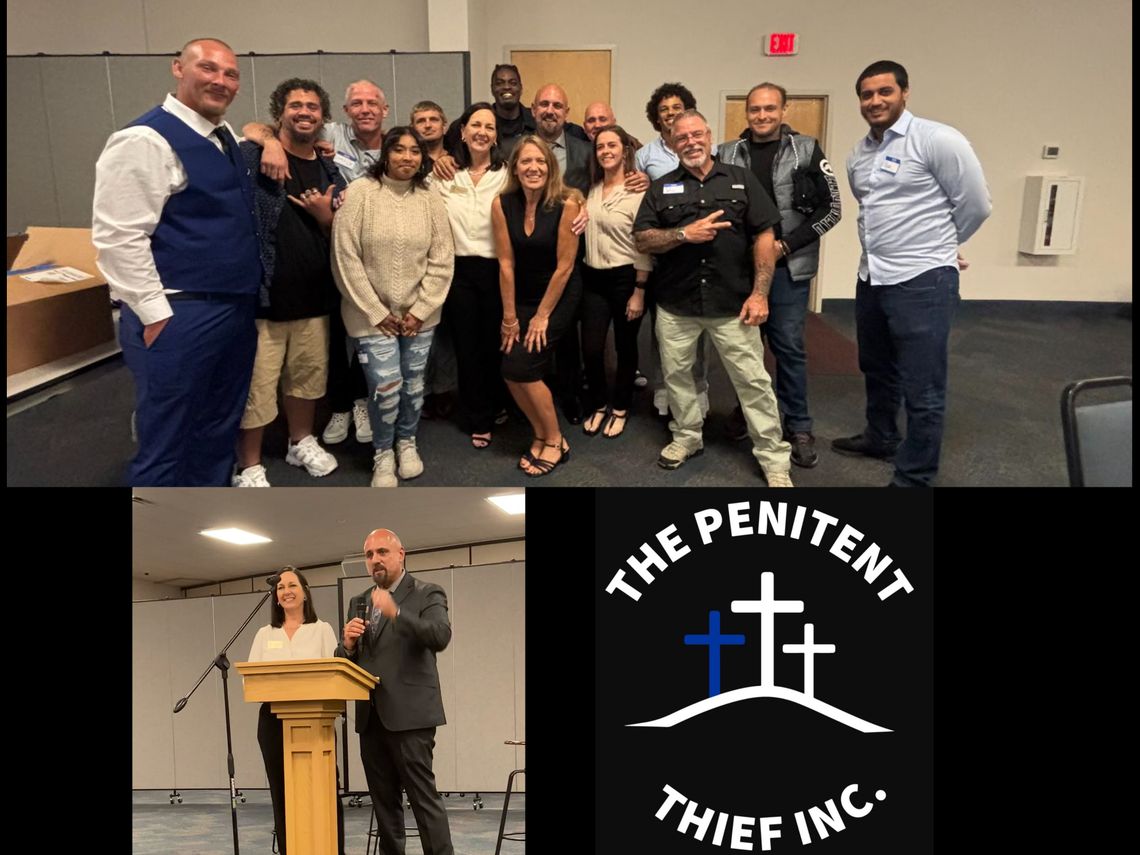
The Penitent Thief is a fully qualified 501(c)3 nonprofit company that is investing in the lives of reintegrated citizens just coming out of jail or prison in Central Florida.
The nonprofit organization helps to ensure success for those willing to participate in becoming productive members of society through counseling, education, skills training, need-based financial assistance, and in-person classes.
The Penitent Thief Inc. is named after the “good thief”, who was one of the two unnamed thieves alongside Jesus through his crucifixion in the New Testament. The Gospel of Luke in the Bible, describes the “good thief” asking Jesus to "remember him" when Jesus comes into his kingdom.
The calling to begin this organization came to a man that served time himself. Paul Del Favero is the President and founder of the Penitent Thief. Del Favero said this all started with a calling from the Lord to talk about his story and spread his message of overcoming reintegration after a sentence.
Del Favero gives much credit to his wife, Stacy Del Favero, for supporting him and helping to make this idea come to life. Mrs. Del Favero assists in all aspects of the program and this married couple acts as a team to break new barriers in community outreach.
What makes work like this so important? Let’s look at some statistics of recidivism in Florida. Recidivism means the tendency of a convicted criminal to reoffend.
According to the Florida Department of Corrections, 33% of individuals released from prison are rearrested within three years.
Looking at the bigger picture, the organization's site states that Florida has the third largest prison population in the country with over 87,000 in state prison and over 30,000 Florida prisoners are released and re enter our communities each year.
There are many contributing factors leading to recidivism, here are some of the most common.
1.Lack of Support System- Research from the National Institute of Justice shows that individuals with weak social networks and family support are more likely to reoffend.
2.Unemployment- Research from the Bureau of Justice Statistics states that individuals who find stable employment post-release have lower recidivism rates compared to those who do not.
3.Substance Abuse- Research from the Substance Abuse and Mental Health Services Administration explains individuals with untreated substance abuse issues substantially increases the likelihood of reoffending.
4.Mental Health Issues- Research from the National Alliance on Mental Illness found individuals with untreated mental health conditions have higher rates of recidivism.
5.Education Attainment- According to a study done by the RAND Corporation (an American nonprofit global policy think tank), individuals who participate in educational programs while incarcerated are 43% less likely to recidivate.
Those are just some of the many contributing factors affecting the reintegrated community. For some perspective, in a study conducted by Urban Institute research, if the Florida time served requirement were reduced from 85% to 65%, the prison population would drop 11%, and 92% of those released would experience no increased likelihood of rearrest.
Mr. Del Favero’s story starts at the age of 13 when he began using drugs and that eventually turned to hard drugs at 15. At 20, he was incarcerated and sentenced to serve 25 years in prison for property crime convictions. While stuck on the inside, he spent his time reading the Bible and learning about, in his words, this “Jesus dude he kept hearing about.”
While in prison, Mr. Del Favero said it took him about 10 years to start figuring out who he was as a person.
“So, here I am in prison. I tell everyone it took me about a solid 10 years in prison, to start getting myself under control, to start getting into the word, and starting to try to figure out who I was as a person,” said Mr. Del Favero.
At the start of his faith journey, Mr. Del Favero didn’t know if taking this path was cut out for people like him.
“So, here I am reading the word, like I don’t really know how this is going to look. And then, you know, you step apart. And start feeling like, well man, I don’t know if this is cut out for people like me,” said Mr. Del Favero.
As he got more serious in reading the word of God, he said he realized he is the type of person God specializes in.
“When you really get serious about reading the word and you see how this Jesus dude operated, like contrary to what your party might be like, people in my situation, we’re like in his wheelhouse. Like, we’re the kind people in the scripture that says he’ll leave the 99 to go after the one lost,” said Mr. Del Favero.
After getting out 18 and a half years later, he felt he was being born into a new world again. Mr. Del Favero said his first three years out, he didn’t talk. He just tried to study people because he said he didn’t really know how the world worked.
“I didn’t know what this whole “wee-fee” thing was at the bottom corner of my computer screen,” said Mr. Del Favero while he laughed.
Mr. Del Favero read almost 5,000 books throughout his sentence and he said anything he heard about he tried to read. He also took up a skill in carpentry.
“I started reading carpentry books and magazines, because Jesus was a carpenter and I figured if it was good enough for him, it’s good enough for me, because I never had a job in my life,” said Mr. Del Favero.
Mr. Del Favero went on to have a great career in carpentry after getting introduced to people and getting some breaks, he said certain people offered him some avenues to do better, and that is just what he did. He eventually ended up managing over 60 people at one point, managing over 10-million-dollar equipment and handling multi-million-dollar projects for an industrial technology company. He explained how that is what happens when you get some good mentorship and you let God really show up in your life.
Even through his success, he said he kept hearing the Lord calling him to share his story.
“God just got in my business and he’s like, hey man, I’ve done a lot for you since you’ve been out here. You know what you’re supposed to be doing,” said Mr. Del Favero.
Mr. Del Favero continued to explain the vision that God had for him.
“God said not only do I want you to go back to the prisons and tell them everything I’ve done for you, but you need to go back and tell them all the stupid, boneheaded mistakes you’ve made, all the times you’ve played in gray areas, all the times you’ve risked your freedom since you been out that I shielded you from, tell them that too,” said Mr. Del Favero.
Shortly after, Mr. Del Favero ended up quitting his job to start a non-profit. He then began teaching his first class at the Polk Correctional Main Unit in Oct. of 2022.
Mr. Del Favero wrote on the organization’s blog that he felt absolutely blessed and inspired to have six students attend that class, three of which had been incarcerated over a quarter of a century each. Classes continued wherever Mr. Del Favero was invited, including Polk Correctional, Osceola County Jail, and other locations.
Fast forward to today, the Del Faveros and other board members of the Penitent Thief have grown in their ways of assisting the reintegrated community.
The Penitent Thief Inc. currently has five homes and one family home that is housing around 30 members throughout different cities in Central Fl. Some ways they assist members are finding appropriate mental health counseling, helping with the job application process, or finding community resources that a citizen might need. So, what does a day of volunteering look like?
According to the company’s webpage, a day of volunteering can look like providing transportation to places like the DMV, a job interview, the Social Security office, or even a trip to Walmart for some basic necessities. It can also be sitting down and showing someone how to operate a smartphone, fill out an application, set up an email account, or even help someone open a bank account.
These tasks may sound simple to some, but thinking in another person’s shoes, doing this all for the first time can be quite intimidating.
Mrs. Del Favero explained essentially what the students on the inside of these classes are learning.
“We bring a message of Jesus first and foremost, but then we also talk about life lessons. He talks from experience and I talk from being on the other side. I’ve never been incarcerated myself, but just life values,” said Mrs. Del Favero. “I’m more of a mentor type role with the ladies, but if we could get them to see their value and get them to see how they deserve what everybody deserves, you know for example that better job. That’s what we focus on.”
Mr. Del Favero gives a lot of gratitude to the organization’s partners that make assisting this community possible.
“We have great partners and you know what the funny part is, when we started this, I was worried about the resource part. Like, how are we going to meet all of this need, it’s just a plethora. It’s like a vortex of need. That was actually the easiest part, finding those resources,” said Mr. Del Favero.
One partner of the Penitent Thief Inc. is DOC Grown, an affiliated company formed as a platform to provide living wage employment for individuals in the organization. The company provides moving/transportation services, construction services, and numerous other jobs.
Kameron Shellman, a member of the Penitent Thief family, talked about the sad reality of coming out of prison, “handicapped” in a way.
“Before prison, I had a great career, a great job and everything, but I didn't know that I would come out of prison handicapped. A lot of people come out of prison handicap because they tell you that you served your time, you paid your debt to society. But, then when you get out, no one wants to hire you. And then if they do want to hire you, it's for underpaid, cheap labor. Then, most people go back, because how can you feed your family?” said Shellman.
Shellman goes on to say why he appreciates what this organization is doing.
“I give thanks to what this organization is doing because they’re helping us find work. Not even just that. Mr. Del Favero pushes all the time, how we need to start our own business so that we can help the ones coming after us. So, that’s my goal now,” said Shellman.
Jessica Freire is also a member of the organization and was a student in these classes while in Osceola County Jail. Freire talked about how important seeds were planted while participating in these classes.
“When I was in Osceola County Jail, he would just say stuff or even Stacy would say things and it was just like little seeds that were being planted that I didn’t realize I was going to use in my everyday life,” said Freire.
Freire goes on to add how the organization’s homes don’t feel like a program or institution but a real family.
“There’s other houses you go into, and you’re going to have to pay programs fees or rent. Let’s say you’re behind on money, there’s no chance you know, you’re kicked out. Like, now it feels like I live in my parents house and I have a roommate, and then my parents are coming to knock at my door, it just feels like a home. Not necessarily a program or institution,” said Freire.
Mr. Del Favero talked about the organization's overall vision and goal.
“Like, our overall vision, our goal here has got nothing to do with me and my wife. We’re just kind of trying to get it started, to show up and give God an opportunity to work through us. It’s not about us, it’s about them getting established, telling their story and helping the people coming behind them,” said Mr. Del Favero.
To keep up to date with fundraisers and events or to find out how to volunteer, you can visit https://www.thepenitentthief.org/